
This guide breaks down the real causes behind concrete driveway cracking, what's within your control to prevent, and what warning signs to watch for before minor cracks become expensive structural problems.
Why Concrete Cracks at All
Understanding why concrete cracks starts with understanding what concrete actually is. Concrete isn't a monolithic, inert slab – it's a chemically active material that moves, expands, contracts, absorbs water, and responds to the loads placed on it. The same properties that make it strong also make it vulnerable under the right conditions.
Fresh concrete contains a significant amount of water as part of the mixing process. As that water evaporates during curing, the concrete shrinks – sometimes as much as 1/16 inch for every 10 feet of length. That shrinkage creates internal tensile stress. When that stress exceeds the tensile strength of the concrete at any point, a crack forms. This is called plastic shrinkage cracking, and it happens to virtually every concrete pour to some degree. The goal of good installation practice isn't to eliminate this entirely – it's to control where it happens and minimize its severity.
Beyond the initial cure, concrete continues to expand and contract with temperature changes throughout its lifetime. The coefficient of thermal expansion for concrete means that a 50-foot driveway expands and contracts approximately 3/8 inch between extreme summer and winter temperatures. That movement has to go somewhere. Without designed relief points, it concentrates at the weakest locations and produces cracks.
The relationship between concrete and water is also ongoing. Concrete is porous, and water moving through it – whether from rain, irrigation, or groundwater – affects its structural integrity over time, particularly when that water freezes.
The Most Common Causes of Driveway Cracking
Freeze-Thaw Cycles
In cold climates, freeze-thaw cycling is the single most destructive force acting on concrete driveways over their lifetime. Water enters the porous concrete surface, freezes, and expands by approximately 9% in volume. That expansion exerts enormous internal pressure – enough to fracture the concrete from within. Over dozens or hundreds of freeze-thaw cycles across multiple winters, the cumulative damage compounds from hairline surface cracks into spalling, delamination, and structural fractures.
Deicers accelerate this damage significantly. Sodium chloride (rock salt), calcium chloride, and magnesium chloride all draw water into the concrete surface and increase the frequency of freeze-thaw cycles within the material itself, even when air temperatures are above freezing. Calcium chloride is particularly aggressive – it can cause surface scaling in concrete that's less than a year old and hasn't fully carbonated. If you use deicers on your driveway, transitioning to sand or grit for traction and reserving chemical deicers for extreme situations only is one of the most impactful protective decisions you can make.
Improper Subbase Preparation
The concrete slab you see is only as stable as what's underneath it. A driveway slab needs a compacted, stable subbase – typically 4–6 inches of compacted gravel – to distribute the load of vehicles evenly and provide consistent support across the entire slab surface. When the subbase is poorly compacted, uses inadequate material, or settles unevenly after installation, the concrete slab loses support in those areas. Under vehicle load, unsupported concrete spans flex and crack because concrete is strong in compression but weak in tension.
This is why driveways in otherwise identical climates and soil conditions can perform very differently. The quality of the subbase preparation – invisible once the concrete is poured – determines much of the driveway's long-term performance. Unfortunately, subbase quality is almost entirely in the hands of the contractor at the time of installation. Homeowners buying an existing property have limited visibility into what's beneath their driveway until problems emerge.
Signs of subbase failure include cracks with vertical displacement (one side of the crack higher than the other), a hollow sound when you tap the slab surface, or visible depression in sections of the driveway after heavy rain or wet weather.
Inadequate Concrete Mix and Thickness
Residential driveways should be poured at a minimum of 4 inches thick, with 5–6 inches recommended in areas with harsh winters or frequent heavy vehicle traffic. Slabs poured thinner than 4 inches lack the structural depth to resist cracking under vehicle loads, particularly near edges where support is reduced. Edge cracks – running parallel to the driveway edge about 6–12 inches inward – are a frequent indicator of insufficient slab thickness or subbase support near the perimeter.
The concrete mix itself matters as well. A mix with too high a water-to-cement ratio (often the result of adding excess water on site to make the mix easier to work) produces concrete with significantly reduced strength and increased porosity. The compressive strength of a properly mixed residential concrete should be 4,000 PSI minimum. Higher water content dilutes this, producing a weaker, more porous surface that's more vulnerable to scaling, cracking, and freeze-thaw damage.
Air entrainment – the intentional introduction of microscopic air bubbles into the concrete mix – is a critical specification for concrete in freeze-thaw climates. These tiny air pockets provide relief space for freezing water to expand into, dramatically reducing internal pressure and freeze-thaw damage. Concrete for driveways in cold climates should specify 5–7% air entrainment. This is a mix specification you can request and confirm with a concrete contractor before pour day.
Missing or Incorrectly Placed Control Joints
Control joints are the deliberate saw cuts or tooled grooves you see running across concrete driveways at regular intervals. They're not decorative – they're engineered crack management. By creating a weakened plane in the concrete at controlled locations, control joints guide shrinkage cracks to happen where the contractor wants them rather than randomly across the slab surface. A crack that happens inside a control joint is invisible and structurally harmless. A crack that forms randomly across an uncontrolled slab surface is what creates the visible, water-collecting fractures that lead to further damage.
Control joints should be placed at intervals no greater than 2–3 times the slab thickness in feet – meaning a 4-inch slab should have control joints every 8–12 feet. They should also be cut to a depth of at least 1/4 of the slab thickness (1 inch for a 4-inch slab) to be effective. Joints that are too shallow or too widely spaced fail to direct cracking reliably, and random cracks form between them.
If your driveway has long unbroken slab sections without control joints – particularly a common issue with older driveways – that's a significant contributor to any cracking you're seeing. It can't be retroactively corrected without significant work, but it's useful to understand as context for why the pattern of cracking looks the way it does.
Tree Roots
Tree roots are a slow but relentless cause of concrete driveway damage that most homeowners underestimate until the damage is already significant. Roots grow toward moisture and nutrients, and the soil alongside and beneath a driveway often retains both. As roots grow in diameter, they exert upward pressure on the slab from below – enough to crack, lift, and displace concrete sections over time. The characteristic pattern is a crack or raised section near the driveway edge adjacent to a tree, sometimes with visible root activity if you look at the soil alongside the slab edge.
Prevention is straightforward if addressed before installation: maintain a minimum 10-foot buffer between a new driveway and established trees, and install a root barrier if the driveway must pass near significant trees. After the fact, options are more limited. Surface repairs won't hold long if root pressure continues. Root removal or redirection by an arborist, followed by subbase correction and concrete replacement in the affected section, is the more durable solution.
Heavy Vehicle Loads
Residential concrete driveways are designed to handle standard passenger vehicles – cars, SUVs, and pickup trucks. They are not designed for repeated heavy vehicle loads: large RVs, commercial delivery trucks, loaded concrete mixers, or dumpster trucks. A single pass from a vehicle significantly exceeding the design load can fracture a concrete slab, particularly near edges or over any subbase voids.
If heavy vehicles access your property regularly – for deliveries, construction, or storage of a large RV – reinforcing the affected areas with additional thickness (6 inches minimum) and proper rebar during installation is the right preventive approach. After the fact, placing timber or steel plates under heavy vehicles to distribute the load is a practical workaround that reduces point loading on the slab surface.
Poor Drainage and Water Accumulation
Water sitting on or pooling against a concrete driveway accelerates almost every other degradation mechanism. It increases freeze-thaw cycling frequency, saturates the subbase causing uneven settlement, wicks into surface cracks and widens them, and promotes the growth of moss and vegetation that mechanically widen cracks over time.
Driveways should be graded to shed water to the sides rather than allowing it to pool on the surface. The standard is a 1/8 to 1/4 inch slope per foot of driveway width toward the edges. Downspout discharge directed onto or alongside a driveway is a common drainage problem that's easy to overlook and simple to correct with a downspout extension.
Prevention: What You Can Control
At the Time of Installation
If you're having a new driveway poured or replacing an existing one, the decisions made before and during the pour have a larger impact on longevity than anything you can do after the fact.
Specify a minimum 4-inch slab thickness – 5 inches in cold climates or where heavy vehicles are expected. Confirm the subbase is compacted gravel at least 4 inches deep, properly graded for drainage. Request a 4,000 PSI minimum concrete mix with 5–7% air entrainment if you're in a freeze-thaw climate. Confirm that control joints will be placed at maximum 8–12 foot intervals and cut to a depth of at least 1 inch. Ask whether fiber reinforcement (polypropylene or steel fiber added to the mix) will be used – it significantly reduces plastic shrinkage cracking in the critical early cure period.
Get these specifications in writing before work begins. A reputable contractor will have no objection to confirming them. Resistance or vagueness about these specifics is a meaningful warning sign.
Sealing and Ongoing Maintenance
A penetrating concrete sealant applied to a properly cured driveway (minimum 28 days after pour for new concrete) dramatically reduces water infiltration – the root mechanism of freeze-thaw damage and several other degradation pathways. A quality siloxane or silane-siloxane penetrating sealant soaks into the concrete surface rather than sitting on top of it, repelling water without altering the appearance or texture of the driveway.
Seal a new driveway once it's fully cured and then reseal every 2–3 years as part of routine maintenance. Clean the surface before sealing and ensure it's fully dry. This single maintenance habit has a larger impact on concrete longevity than almost any other action available to a homeowner.
Deicer Management
Reduce or eliminate chemical deicer use on your concrete driveway, particularly during the first two winters when the concrete is still gaining strength and hasn't fully carbonated. Sand or kitty litter provides traction without chemical attack. If you do use deicers, avoid calcium chloride and sodium chloride on concrete surfaces. Potassium chloride is somewhat less aggressive, though still not ideal for regular use. Clear accumulated salt from the surface in spring with a thorough hose-down.
Water and Drainage Management
Redirect downspouts away from the driveway surface and verify that the driveway grades water toward the edges rather than the center or toward the foundation. Keep gutters clear so water doesn't overflow onto the driveway surface during heavy rain. Address any low spots where standing water accumulates after rain – either through surface repair to level the area or by improving the grade of adjacent soil.
Filling Cracks Promptly
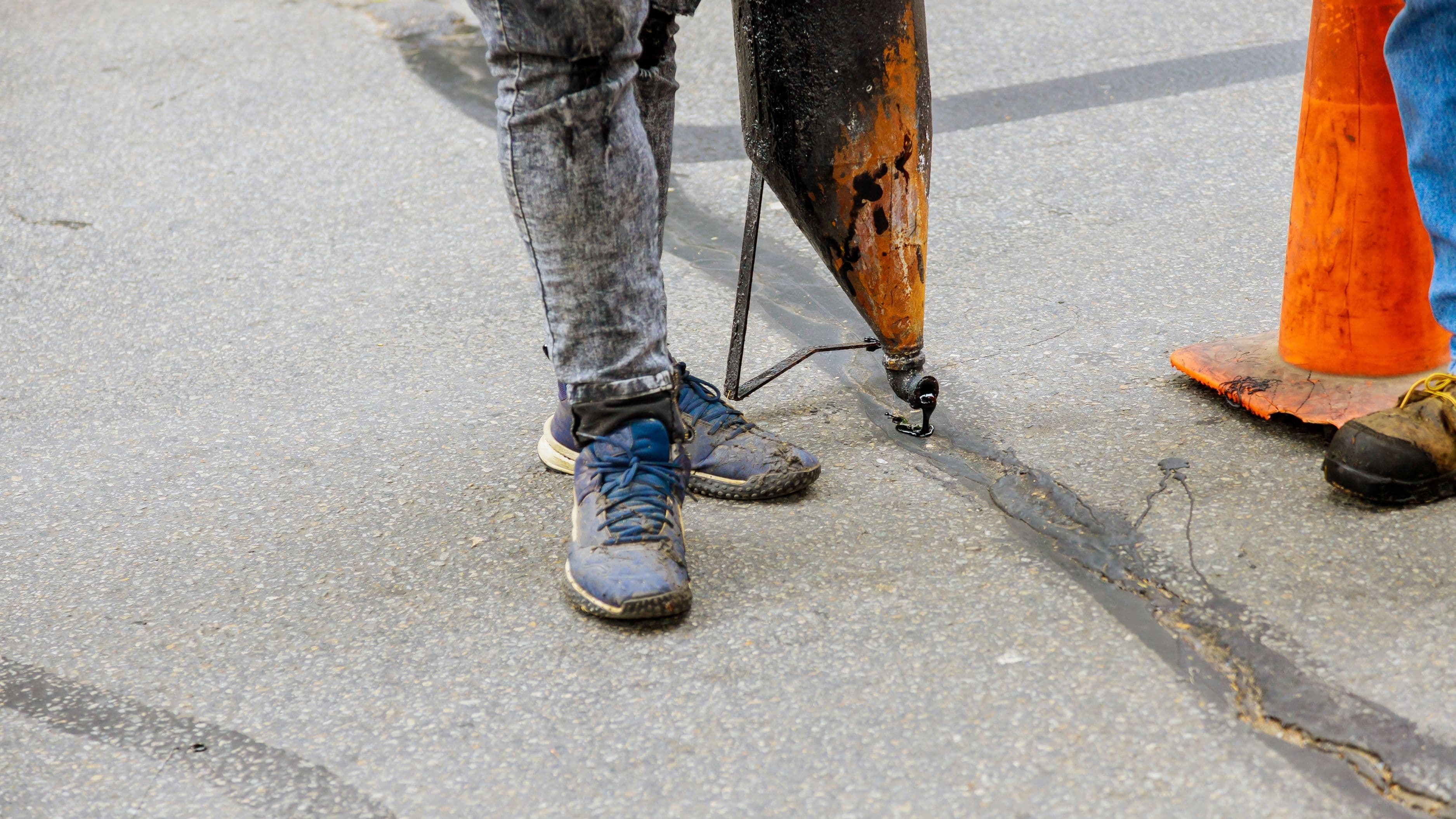
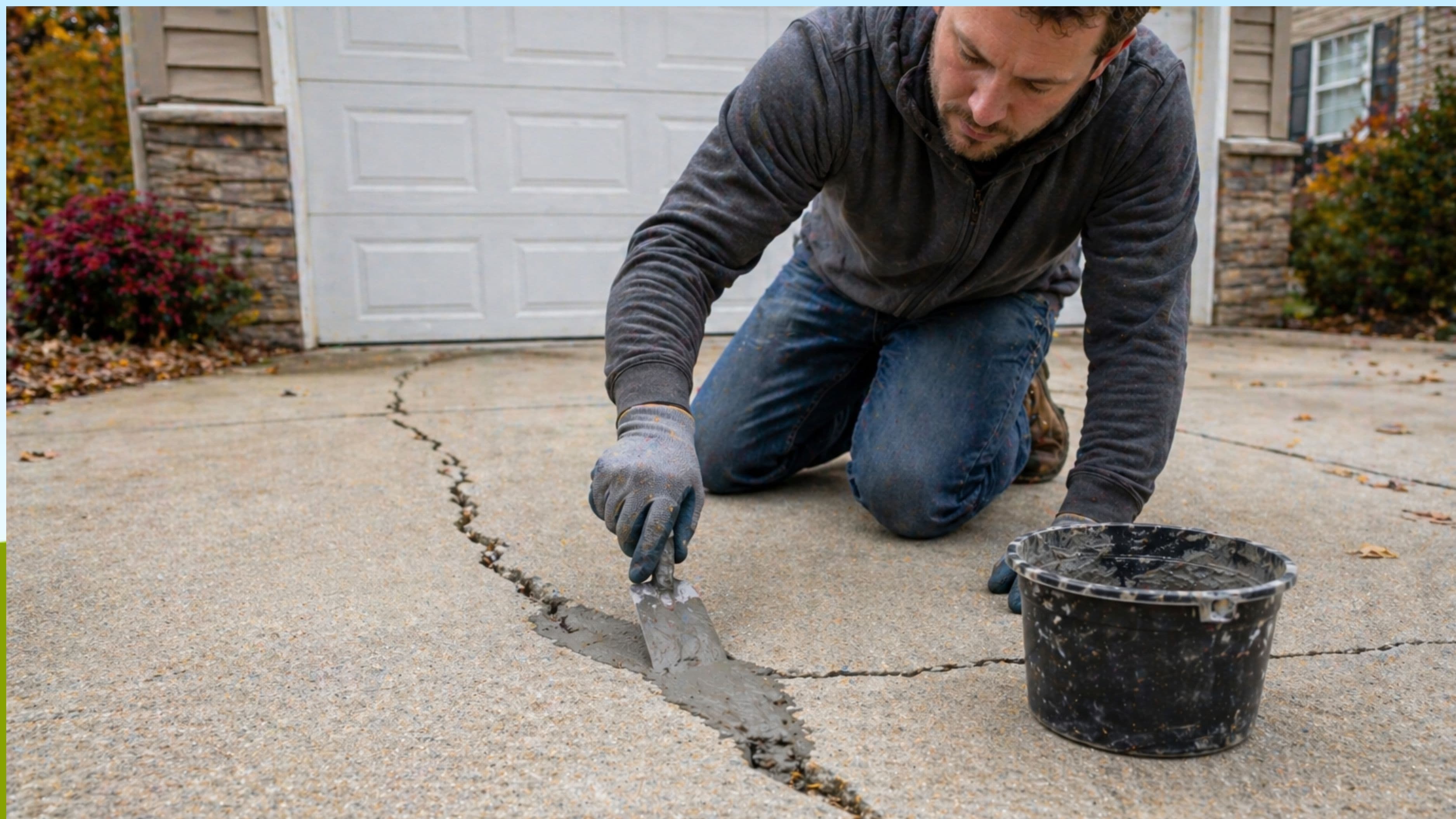
Small cracks sealed promptly stay small cracks. Left open, water infiltration, freeze-thaw action, and vegetation growth progressively widen them. A hairline crack that's sealed in fall costs $5 in materials and 20 minutes of effort. Left through one winter, it may become a 1/2-inch crack that requires a proper patching repair. Left another season, it may involve vertical displacement and subbase correction. Early intervention is overwhelmingly the right economic decision.
Warning Signs to Watch For
A few patterns in driveway cracking indicate problems that go beyond normal surface wear and deserve attention before they escalate.
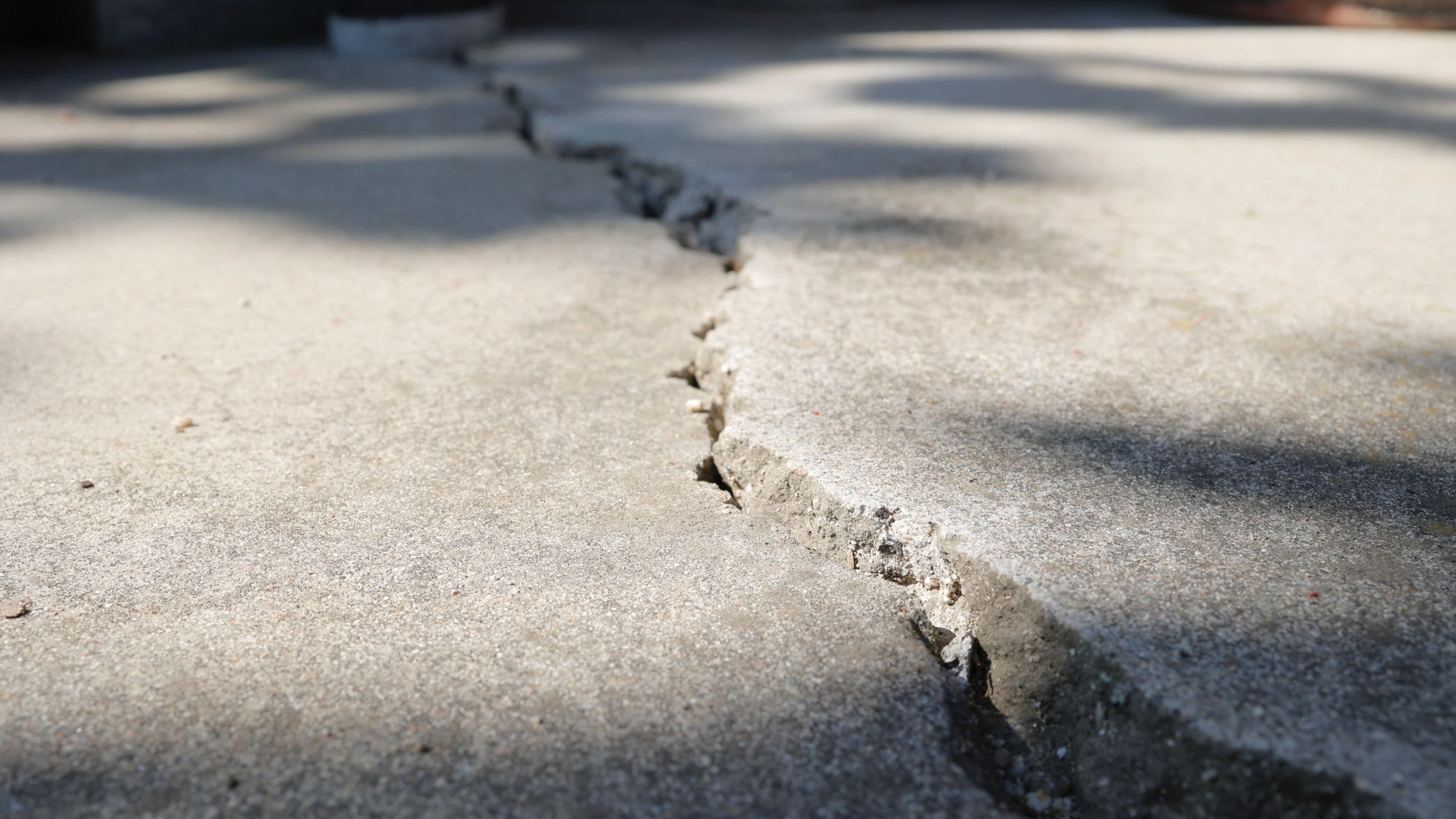
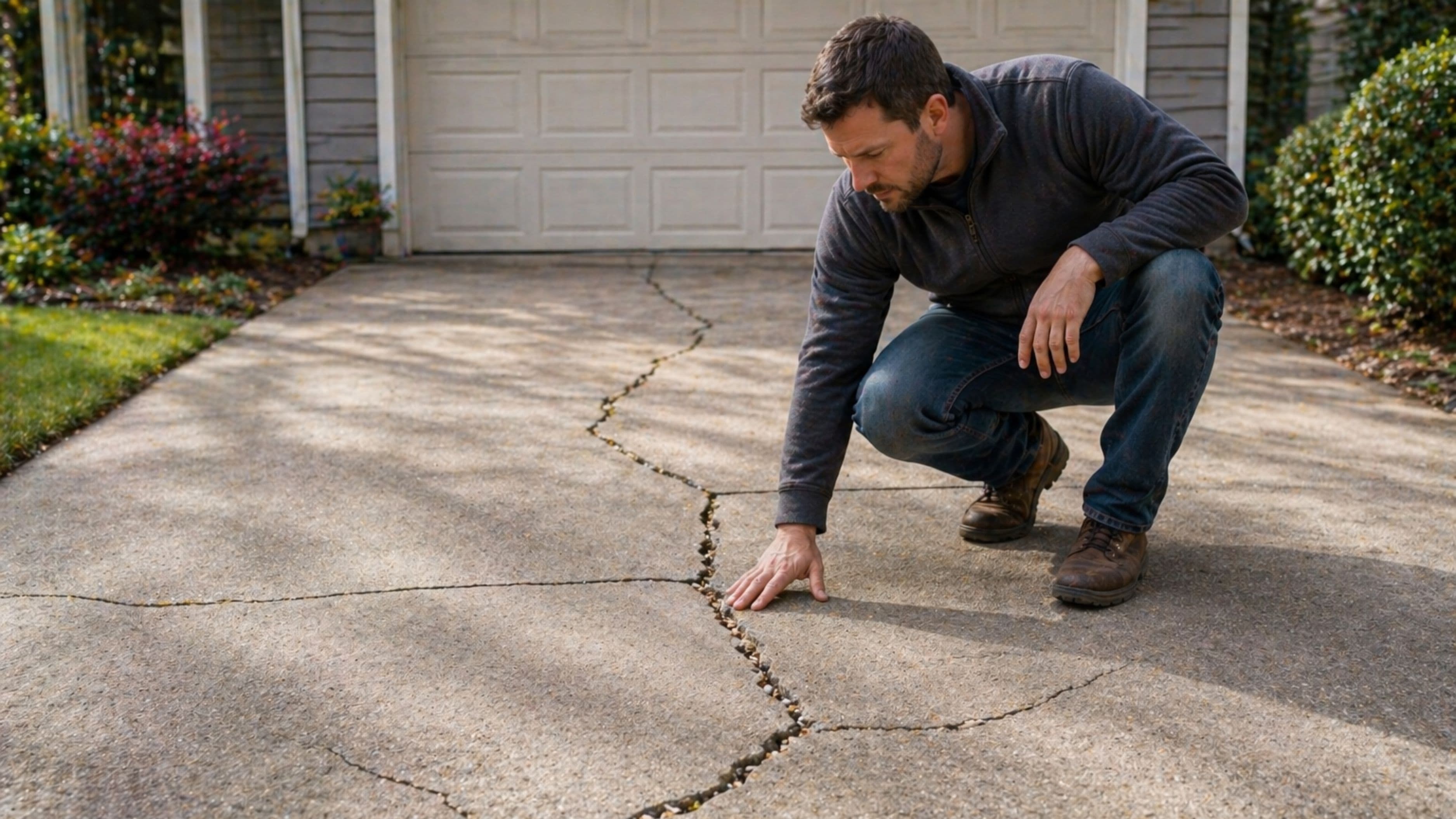
Cracks with vertical displacement – where one side of the crack is higher than the other – indicate uneven subbase settlement or root pressure rather than simple surface shrinkage. Surface filling helps temporarily but won't stop the progression.
Multiple diagonal cracks radiating from a corner of a slab section suggest the corner is undermined – lacking subbase support directly beneath it. This pattern often occurs near downspout discharge points or at the base of slopes where water concentrates.
A network of interconnected cracks in a roughly hexagonal or map-like pattern (called "map cracking" or "alligator cracking") across a section of the driveway indicates alkali-silica reaction in the concrete mix or severe freeze-thaw degradation that has penetrated through the slab. In either case, resurfacing or replacement of the affected section is more appropriate than crack filling.
Edges that are crumbling or flaking (spalling) while the main slab body remains intact typically indicate deicer damage or a finishing error during the original pour (over-troweling the surface, which seals bleed water into the upper layer and produces a weak surface skin). A concrete resurfacer addresses the symptom, but eliminating deicer use prevents the progression.
FAQ
Is some cracking in a concrete driveway normal? Yes. Minor surface shrinkage cracking – hairline cracks that are shallow and don't show displacement – is nearly universal in residential concrete driveways and doesn't indicate a quality problem. What separates normal from problematic cracking is width, depth, vertical displacement, and progression over time. Monitoring your driveway annually and sealing small cracks promptly keeps normal shrinkage cracking from becoming a structural issue.
How long should a concrete driveway last? A properly installed concrete driveway with good subbase preparation, correct mix specifications, and regular sealing should last 30–50 years before requiring replacement. Driveways installed without these specifications may show significant cracking and surface deterioration within 10–15 years, particularly in harsh climates.
Does adding rebar prevent cracking? Rebar (steel reinforcement) doesn't prevent cracking – it prevents the cracked sections from separating and displacing vertically. It holds the slab together even after cracks form, which is why reinforced concrete that cracks still tends to remain flat and functional rather than developing the step-up displacement seen in unreinforced slabs. For residential driveways, welded wire mesh or fiber reinforcement in the mix is often specified as an alternative to rebar that's easier to install correctly.
Can I seal my driveway to prevent cracks from forming? Sealing significantly reduces water infiltration, which reduces freeze-thaw damage and subbase saturation – both major contributors to cracking. It doesn't prevent shrinkage cracking or cracking from subbase movement or root pressure. Think of it as one important layer of protection within a broader maintenance approach rather than a standalone solution.
What's the best time of year to have a concrete driveway poured? Late spring through early fall, when temperatures are consistently between 50°F and 90°F. Concrete poured in cold weather requires heated materials and protection from freezing during cure – manageable but adds cost and complexity. Concrete poured in very hot weather requires accelerated curing management to prevent plastic shrinkage. The moderate temperature window produces the most reliable cure and the strongest finished product.
Concrete driveways crack for specific, understandable reasons – and most of those reasons connect to decisions made during installation or early maintenance. The best investment in a long-lasting driveway is made before the concrete is ever poured: right mix, right thickness, right subbase, right joints. After that, consistent sealing and prompt crack repair keep normal wear from compounding into something more serious. Understanding what's actually happening beneath your driveway surface makes the maintenance decisions straightforward rather than guesswork.
📚 Sources
Concrete Cracking – Causes and Prevention – Portland Cement Association: https://www.cement.org/learn/concrete-technology/concrete-construction/cracking
Freeze-Thaw Resistance of Concrete – American Concrete Institute: https://www.concrete.org/topicsinconcrete/topicdetail.aspx?topicid=22
Deicer Effects on Concrete – Federal Highway Administration: https://www.fhwa.dot.gov/publications/research/infrastructure/structures/bridge/49374
Subbase Preparation for Concrete Flatwork – Concrete Construction Magazine: https://www.concreteconstruction.net/how-to/construction/subbase-and-subgrade-for-concrete-flatwork
Control Joints in Concrete Flatwork – Concrete Network: https://www.concretenetwork.com/concrete/control-joints
Tree Root Damage to Concrete – University of Florida IFAS Extension: https://edis.ifas.ufl.edu/publication/EP445
Concrete Driveway Thickness and Reinforcement Guidelines – QUIKRETE Technical Data: https://www.quikrete.com/pdfs/data_sheet-concrete_mix_1101.pdf